
Animal cells and plant cells are distinct units of life, each with unique structures and functions that suit their roles in nature. Understanding these differences helps us appreciate the diversity of life on Earth. For a detailed exploration of these aspects, check out Animal Cell vs Plant Cell: Key Differences.
Table of Contents
Overview of Animal and Plant Cells
Definition of Animal Cells
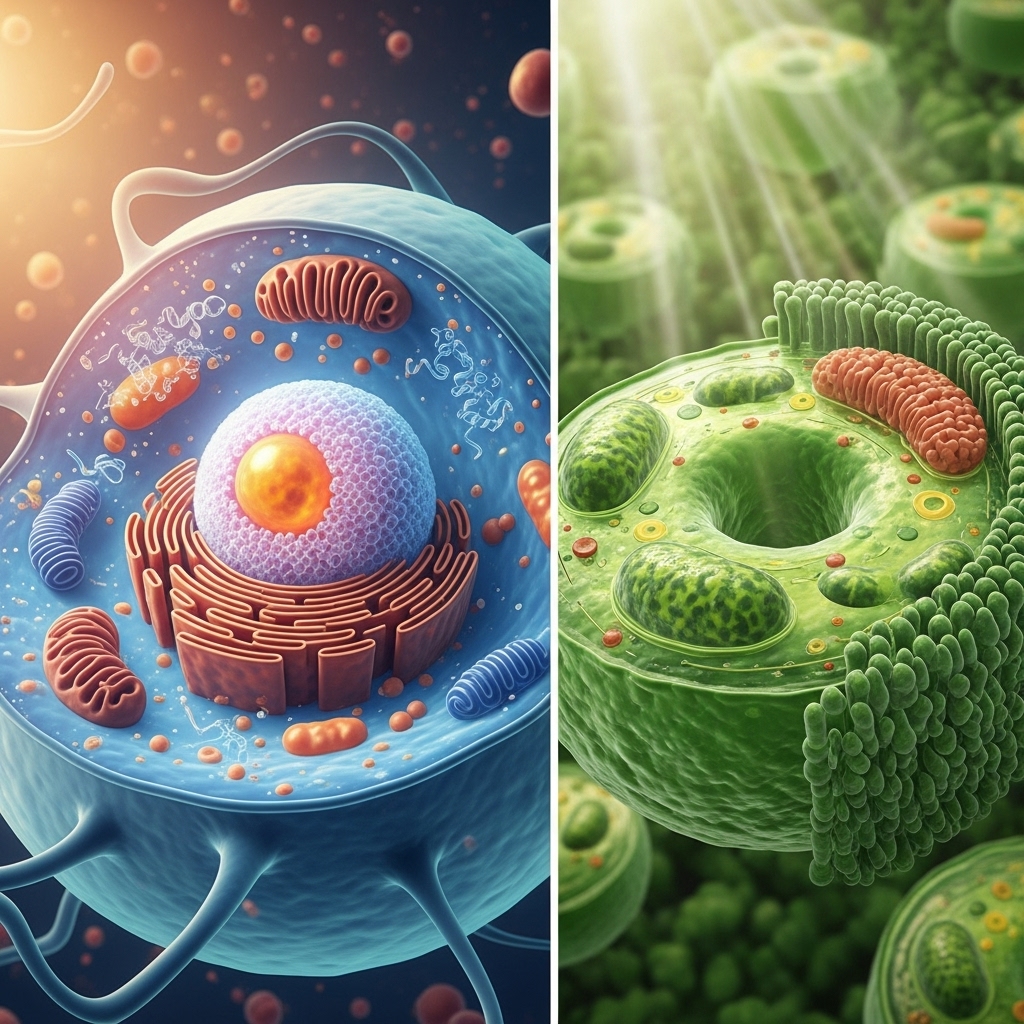
Animal cells are the basic building blocks of animal life. They are typically smaller and more flexible than plant cells, allowing for a variety of shapes and functions. Unlike plant cells, animal cells lack a rigid cell wall, which gives them the ability to change shape easily. In my experience studying biology, I found it fascinating how animal cells are designed primarily for mobility and interaction with their environment. This flexibility allows them to perform a variety of functions, from muscle contraction to nerve signal transmission.
Definition of Plant Cells
Plant cells, on the other hand, are characterized by their rigid structure, which is supported by a cell wall made of cellulose. This added support allows plants to stand upright and reach for sunlight. Plant cells also contain chloroplasts, where photosynthesis, the process of converting sunlight into energy, takes place. I remember the first time I learned about chloroplasts; it felt like discovering a hidden world within plants, where they transform light into life. The unique features of plant cells help them play an essential role in ecosystems as producers, providing energy for all other living organisms.
Importance of Understanding Cell Types
Understanding the differences between animal and plant cells is crucial for several reasons. For one, it sheds light on how different organisms interact with their environments and each other. It also has practical implications in fields like medicine, agriculture, and biotechnology. I’ve often thought about how this knowledge can inform everything from developing new treatments for diseases to enhancing crop yields. By recognizing what makes each cell type unique, we can better appreciate the interconnectedness of life on our planet.
Key Differences Between Animal Cells and Plant Cells
Cell Structure
When I first started exploring the cellular world, I was struck by how the structure of animal cells and plant cells reflects their different roles. Animal cells tend to have a more irregular, varied shape, while plant cells usually have a fixed, rectangular shape due to their cell wall. This difference is more than just aesthetic; it plays a significant role in how each type of cell functions. For instance, the more flexible structure of animal cells allows them to form tissues that can move, such as muscle tissue. In contrast, the rigidity of plant cells helps them maintain structure and support the entire plant.
Cell Wall vs. Cell Membrane
One of the most significant differences between animal and plant cells is the presence of a cell wall in plant cells. The cell wall is a tough layer that surrounds the cell membrane, providing protection and support. I remember my biology teacher explaining that this feature is what allows plants to withstand the pressures of their environment, such as wind and gravity. In contrast, animal cells only have a cell membrane, which is more flexible and allows for the movement of materials in and out of the cell. This difference is crucial for their survival, as animal cells often need to quickly adapt to changes in their surroundings.
Chloroplasts: Presence in Plant Cells
Chloroplasts are another defining feature of plant cells. These organelles contain chlorophyll, the green pigment responsible for capturing sunlight and converting it into energy through photosynthesis. I think about how amazing it is that plants can create their food from sunlight while animals must consume other organisms for energy. This fundamental difference highlights the unique roles each type of cell plays in the ecosystem. Without chloroplasts, plants wouldn’t be able to produce oxygen or food, which are vital for life on Earth. For more on this topic, refer to Animal Cell vs Plant Cell: What? the Difference?.
Vacuoles: Size and Function
Vacuoles are large storage sacs found in plant cells, often taking up a significant portion of the cell’s internal space. They store water, nutrients, and waste products, helping maintain the cell’s internal environment. I recall being surprised to learn that animal cells have vacuoles too, but they are much smaller and more numerous. In my experience, this difference underscores how plant cells are designed to manage large amounts of water and maintain turgor pressure, which keeps the plant upright and healthy.
Shape Variations: Round vs. Rectangular
As I delved deeper into cell biology, I noticed that the shapes of animal and plant cells serve specific functions. Animal cells can be round, oval, or irregular in shape, enabling them to fit together in various arrangements to form tissues and organs. For example, red blood cells are disc-shaped, which helps them efficiently transport oxygen throughout the body. On the other hand, plant cells are typically rectangular, which allows them to stack neatly and form sturdy structures. This organization is crucial for supporting the plant’s overall growth and function, making them resilient to environmental challenges.
Cell Organelles: A Comparative Analysis
Mitochondria in Animal Cells
Mitochondria are often called the powerhouses of the cell, and I can see why. In animal cells, these organelles play a crucial role in converting nutrients into energy through a process called cellular respiration. I remember when I first learned that the energy currency of cells is ATP (adenosine triphosphate). It was fascinating to realize that every movement, thought, and function in our bodies relies on this energy conversion happening inside our cells. The number of mitochondria in a cell can vary depending on its energy needs; for instance, muscle cells have a high concentration of mitochondria because they require a lot of energy for contraction. This adaptability of mitochondria to meet the demands of different cell types truly highlights how tailored our body systems are to function optimally.
Photosynthesis and Chloroplasts in Plant Cells
As I mentioned earlier, chloroplasts are a hallmark of plant cells, and their role is nothing short of remarkable. These organelles allow plants to harness sunlight, making them unique in the kingdom of life. The process of photosynthesis not only provides energy for the plants themselves but also produces oxygen as a byproduct, which is essential for animal life. I think back to my time in the garden, where I would marvel at how plants seem to thrive under the sun, all the while creating the very air we breathe. It’s incredible to think that through photosynthesis, plants are constantly converting light energy into chemical energy, fueling the entire food web. This symbiotic relationship between plants and animals emphasizes the interconnected nature of life. For a deeper understanding, check out Animal Cell vs Plant Cell: Differences Explained.
Ribosomes: Composition and Function
Ribosomes are the tiny factories of both animal and plant cells, responsible for protein synthesis. I often find it interesting how these organelles can be found floating freely in the cytoplasm or attached to the endoplasmic reticulum. In animal cells, ribosomes play a vital role in producing proteins that carry out various functions, from enzymes that aid in digestion to antibodies that fight infections. Plant cells utilize ribosomes in much the same way, but they also produce proteins necessary for photosynthesis and growth. I remember being surprised to learn that ribosomes are made of RNA and proteins, a combination that allows them to perform their essential function effectively. This shared feature between the two cell types showcases the fundamental processes that underlie all life.
Nucleus: Control Center of the Cell
The nucleus is often described as the control center of the cell. In both animal and plant cells, the nucleus houses the genetic material (DNA) and orchestrates cellular activities by regulating gene expression. I found it fascinating to learn that the nucleus is surrounded by a double membrane, providing an extra layer of protection for our genetic information. It’s like the vault that holds our most valuable secrets! I’ve seen how the nucleus plays a role in growth, development, and response to environmental changes. This central role highlights the importance of the nucleus in maintaining the integrity and function of both animal and plant cells, allowing them to thrive in their respective environments.
Endoplasmic Reticulum and Golgi Apparatus
The endoplasmic reticulum (ER) and Golgi apparatus work together like a production line in both animal and plant cells. The ER comes in two forms: rough (with ribosomes) and smooth (without ribosomes). I remember being intrigued by the rough ER, as it’s responsible for synthesizing proteins, while the smooth ER plays a role in lipid synthesis and detoxification. The Golgi apparatus then modifies, sorts, and packages these proteins and lipids for distribution. It’s quite fascinating how this system works in harmony to ensure that all the components of the cell are produced and delivered where they need to go. I think about how, in my own life, we often rely on a similar process when creating something complex, like baking a cake where each ingredient plays a vital role in the final product!
Functionality and Metabolism
Energy Production: Cellular Respiration vs. Photosynthesis
Delving into the energy production processes of animal and plant cells really opened my eyes to their differences. Animal cells rely on cellular respiration to break down glucose and release energy, while plant cells utilize photosynthesis to create their energy source. I was amazed to discover how these processes are interconnected. In a way, animals are dependent on plants not just for food, but also for oxygen produced during photosynthesis. It created a vivid image in my mind of a cycle of life where energy flows seamlessly from one organism to the next. Understanding these fundamentals helps me appreciate the balance of ecosystems and how every living thing plays a part in sustaining life.
Growth and Development Differences
The growth and development of animal and plant cells differ in notable ways. Animal cells undergo growth through cell division and differentiation, allowing them to form various tissues and organs. I remember learning about stem cells and how they have the potential to become different cell types, which was mind-blowing to me. Meanwhile, plant cells can grow in size and number, but their growth is also influenced by factors like light, water, and nutrients. What struck me was the concept of meristematic tissue in plants, which allows them to continue growing throughout their lives. This regenerative capability is something I’ve always admired about plants; they can adapt and thrive, even in challenging conditions.
Reproductive Strategies: Mitosis and Meiosis
When it comes to reproduction, animal and plant cells utilize mitosis and meiosis differently. Mitosis is responsible for growth and tissue repair in both types of cells, but meiosis is where things get interesting. In animals, meiosis leads to the production of gametes, or sex cells, which is crucial for sexual reproduction. I remember the first time I learned about genetic diversity resulting from meiosis, and it truly highlighted the beauty of evolution. Plant cells also undergo meiosis, especially in the formation of spores and gametes, but their reproductive strategies can include asexual reproduction, which allows them to quickly spread and populate an area. This flexibility in reproductive strategies showcases the adaptability of life forms in different environments.
Common Misconceptions About Animal and Plant Cells
Do All Cells Have a Nucleus?
One of the first questions I often hear when discussing cells is whether all cells have a nucleus. This is a common misconception! While animal and plant cells do contain a nucleus, not all cells share this trait. For example, prokaryotic cells, like bacteria, do not have a nucleus. Instead, their genetic material is located in a region called the nucleoid. I remember being surprised by this when I first encountered it in my studies; it made me realize how diverse life can be at the microscopic level. The absence of a nucleus in prokaryotes shows how evolution has taken different paths to adapt to various environments.
The Role of Cell Walls in Animal Cells
Another misconception I encountered was the belief that all cells have a cell wall. It’s easy to see why people might think this, especially since plant cells have a prominent cell wall. However, animal cells do not have a cell wall; they only have a cell membrane. This distinction is crucial because the cell wall provides structural support and protection to plants, while the flexibility of the cell membrane in animal cells allows for dynamic interactions and movements. I remember learning this in class and thinking about how it relates to the functions of different organisms. The absence of a cell wall means that animal cells can be more versatile in their shapes and functions, which is vital for complex organisms like us.
Are Plant Cells Always Larger Than Animal Cells?
People often assume that plant cells are always larger than animal cells, but this isn’t necessarily true. While it’s common for plant cells to be larger due to their vacuoles and rigid structures, there are many exceptions. For instance, some animal cells can be quite large, like nerve cells, which can stretch across long distances in our bodies. In my experience, understanding the size variations has helped me appreciate the complexity of cell types. Size can depend on the cell’s function and environment rather than a strict rule based on whether it’s an animal or plant cell.
Applications of Understanding Cell Differences
Biotechnology and Genetic Engineering
Understanding the differences between animal and plant cells has significant implications in biotechnology and genetic engineering. For instance, scientists can manipulate plant cells to produce proteins necessary for medical therapies or to enhance nutritional content. I remember when I first read about genetically modified organisms (GMOs); it was fascinating to learn how altering a plant’s genetic makeup could lead to improved crop resilience or pest resistance. Realizing that this knowledge can help address food security and health issues around the world was truly eye-opening for me.
Medical Research and Treatments
In the realm of medical research, the unique characteristics of animal cells are crucial for developing treatments and understanding diseases. Animal cells are often used in laboratory settings to test new drugs before they are used in humans. I found it intriguing that researchers can observe how these cells react to various treatments, enabling them to fine-tune therapies. For example, stem cell research has shown potential in regenerative medicine, allowing scientists to explore ways to repair damaged tissues. This intersection of biology and medicine highlights how our understanding of cell types can lead to critical advancements in health care.
Agricultural Practices and Crop Improvement
The differences between plant and animal cells also play a vital role in agriculture. By understanding plant cell functions, farmers can develop better cultivation techniques and pest management strategies. For instance, knowing how plant cells respond to environmental stress can lead to more sustainable farming practices. I remember being amazed by stories of how certain crops can be engineered to be more drought-resistant or have higher yields. This knowledge not only helps feed growing populations but also encourages environmentally friendly practices that can benefit the planet.
Visual Aids for Understanding Cell Structures
Diagrams of Animal Cells
Visual aids are incredibly helpful when learning about cell structures. Diagrams of animal cells often highlight the various organelles, such as mitochondria, ribosomes, and the nucleus. I’ve found that seeing these structures laid out can make it easier to grasp their functions and relationships. For example, illustrations can show how mitochondria are distributed throughout the cell, emphasizing their role in energy production. I often use diagrams when studying because they provide a clear picture of what I’m trying to learn and help reinforce my understanding.
Diagrams of Plant Cells
Similarly, diagrams of plant cells are invaluable for understanding their unique features. They typically include the cell wall, chloroplasts, and large vacuoles, which are not present in animal cells. I recall looking at a detailed diagram for the first time and being struck by the complexity of plant cells. These visual representations can highlight how each part contributes to the cell’s overall function, making it easier to comprehend concepts like photosynthesis. I believe that these diagrams are a crucial tool in education, allowing students to visualize and connect the dots between structure and function.
Comparative Charts of Organelles
Comparative charts of organelles from both animal and plant cells can be a fantastic resource for summarizing differences and similarities. I remember creating a chart during my studies that listed organelles, their functions, and their presence in each cell type. This exercise not only helped me memorize the information but also gave me a clearer perspective on how different structures serve various purposes. Charts like these can be incredibly useful for visual learners and can help anyone quickly grasp the essential features of cells.
Frequently Asked Questions
What are the main differences between animal cells and plant cells?
Animal cells are smaller and more flexible, lacking a rigid cell wall, while plant cells have a fixed, rectangular shape supported by a cell wall made of cellulose. Plant cells also contain chloroplasts for photosynthesis, which animal cells do not have.
What is the role of chloroplasts in plant cells?
Chloroplasts are organelles found in plant cells that contain chlorophyll, enabling plants to capture sunlight and convert it into energy through the process of photosynthesis. This process is essential for producing oxygen and food, vital for life on Earth.
How do animal cells produce energy?
Animal cells produce energy through cellular respiration, which involves breaking down glucose to release energy in the form of ATP (adenosine triphosphate). Mitochondria play a crucial role in this energy conversion process.
What is the function of vacuoles in plant and animal cells?
Vacuoles in plant cells are large storage sacs that maintain the cell’s internal environment by storing water, nutrients, and waste products. Animal cells also have vacuoles, but they are smaller and more numerous, reflecting their different roles in managing resources.
Do all cells have a nucleus?
No, not all cells have a nucleus. While animal and plant cells do contain a nucleus, prokaryotic cells, such as bacteria, do not have a nucleus and instead have their genetic material located in a region called the nucleoid.
What is the significance of the cell wall in plant cells?
The cell wall in plant cells provides structural support and protection, allowing plants to withstand environmental pressures like wind and gravity. This rigid structure is essential for maintaining the plant’s upright position and overall health.
How do animal and plant cells differ in their growth and development?
Animal cells grow through cell division and differentiation, forming various tissues and organs. In contrast, plant cells can grow in size and number, influenced by factors such as light, water, and nutrients, and they have meristematic tissue that allows continuous growth.
What are ribosomes and what role do they play in cells?
Ribosomes are organelles responsible for protein synthesis in both animal and plant cells. They can be found freely floating in the cytoplasm or attached to the endoplasmic reticulum and are crucial for producing proteins necessary for various cellular functions.
How does photosynthesis in plant cells benefit animal life?
Photosynthesis in plant cells produces oxygen as a byproduct, which is essential for animal life. Additionally, plants create their food from sunlight, forming the base of the food web that sustains all other living organisms.
What applications arise from understanding the differences between animal and plant cells?
Understanding these differences has significant implications in biotechnology, medical research, and agriculture. This knowledge can lead to advancements in genetic engineering, medical treatments, and improved agricultural practices that enhance crop resilience and yield.